Scaffold erection risk assessment. A printable risk assessment for erecting, altering and striking a scaffold — the hazards of the job itself rather than of the finished structure.
This is the paper version. ScaffoldOptix does the same job on a phone, with the record filed against the scaffold and the site automatically.
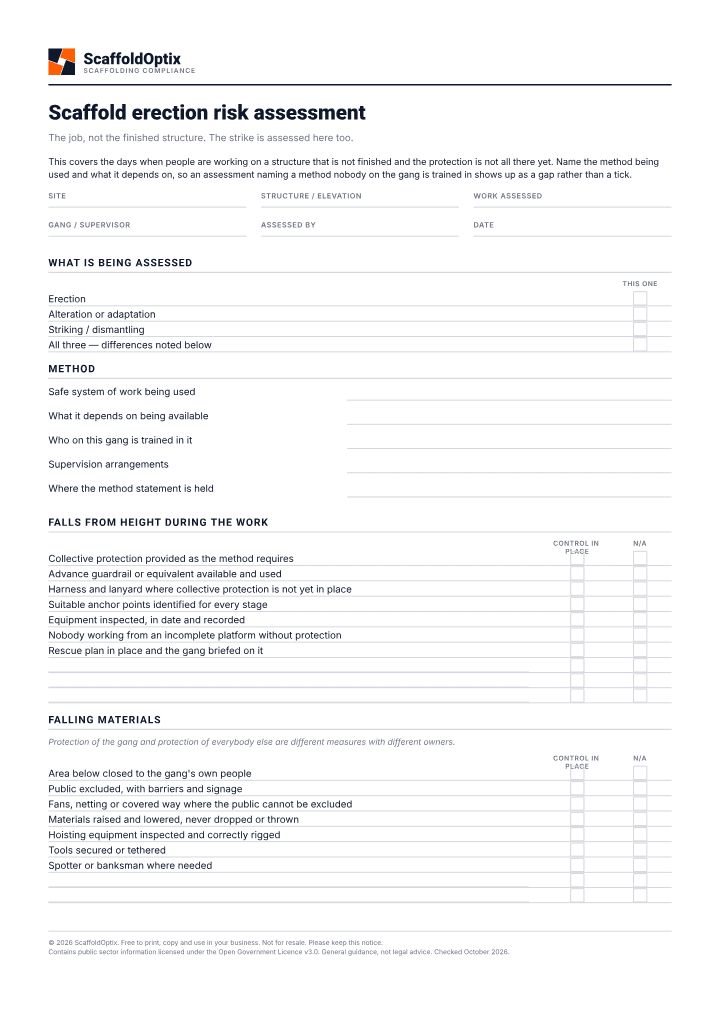
What is on the sheet
- Site, structure, the gang and the work being assessed — erection, alteration or strike
- Falls from height during erection, and the collective and personal measures in place
- Falling materials and the protection of people below, including the public
- Manual handling, lifting, hoisting and how materials reach the lift
- Ground conditions, services, excavations and what the scaffold stands on
- Weather, overhead services, traffic and public interface, each with the control and who is responsible for it
Why this record matters
This is an assessment of the job, not of the scaffold. The finished structure is dealt with by the design and the inspection regime; what this covers is the few days when people are working on a structure that is not finished and the protection is not all there yet — which is when scaffolders are hurt.
The hazard that dominates is falling during erection, and the controls for it are the subject of the industry's own guidance rather than of a generic form. The sheet asks what method is being used and what it depends on, so that an assessment naming a method nobody on the gang is trained in is visible as a gap rather than as a tick.
Falling materials runs it close, and it is the one with the public in it. A scaffold going up over a pavement is a different job from the same scaffold in a compound, and the sheet separates the protection of the gang from the protection of everybody else because they are different measures with different owners.
The strike is assessed on the same sheet as the erection on purpose. Striking is not erection in reverse — the structure is being progressively weakened rather than progressively completed, and the temptation to drop materials is at its highest. An assessment that covers only the build has covered the easier half.
Use it with
- Rescue plan for work at heightA printable rescue plan for a scaffolding gang — how somebody in a harness gets down, who does it, with what, and how long it is expected to take.
- Scaffold design briefA printable design brief for commissioning a scaffold design — the information a designer needs before they can design anything, gathered once rather than over a fortnight of phone calls.
- Scaffold adaptation recordA printable record of an alteration to a scaffold — what changed, who authorised it, who did it, and the inspection that has to happen before it is used again.
Read more on this
© 2026 ScaffoldOptix. Free to print, copy and use in your business. Not for resale. Please keep this notice.
Contains public sector information licensed under the Open Government Licence v3.0. General guidance, not legal advice. Checked October 2026.