Rescue plan for work at height. A printable rescue plan for a scaffolding gang — how somebody in a harness gets down, who does it, with what, and how long it is expected to take.
A plan on paper is not a rescue capability. The training, the equipment and the practice are what make it real, and neither this sheet nor ScaffoldOptix provides them — what the platform does is keep the plan with the site and the competence records with the people, so you can see before the day whether the gang on site can actually carry it out.
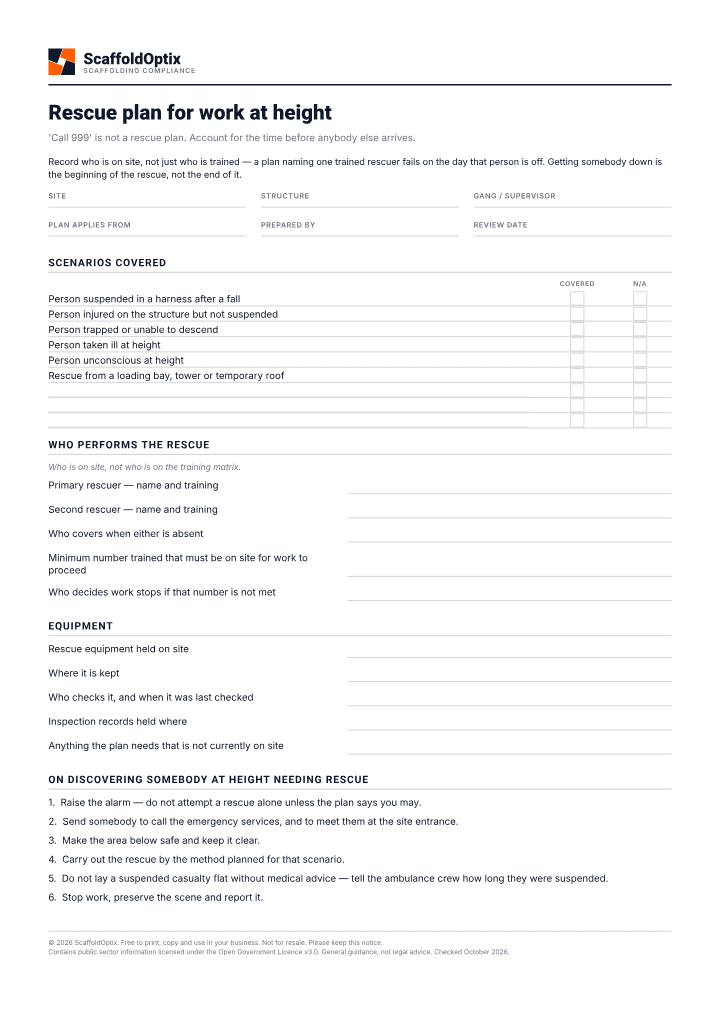
What is on the sheet
- Site, structure, the gang and the date the plan applies from
- The foreseeable scenarios: suspended in a harness, injured on the structure, trapped, taken ill at height
- Who performs the rescue, who is trained to, and who is on site on any given day
- The equipment, where it is kept, and who checks it
- How the alarm is raised, who calls the emergency services, and who meets them
- Suspension trauma and the handover to medical help, and a review block for when the structure or the gang changes
Why this record matters
The Work at Height Regulations require planning for emergencies and rescue, and 'call 999' is not a rescue plan. A person suspended in a harness is on a clock, and the plan has to account for the time before anybody else arrives — which on most sites is the only time that matters.
The weakness in nearly every plan is availability. A plan that names one trained rescuer is a plan that fails on the day that person is off, and a plan written for a four-person gang does not work for the two who are there on a Friday. The sheet asks who is on site rather than who is trained, because those are different questions.
Suspension trauma is on the sheet because it changes what the rescue is for. Getting somebody down is the beginning of it, not the end, and a plan that stops at ground level has planned half an emergency.
This is a soft download and honestly so. Writing a rescue plan is straightforward; being able to carry it out needs training, equipment and practice, and no form supplies any of those.
Use it with
- Scaffold erection risk assessmentA printable risk assessment for erecting, altering and striking a scaffold — the hazards of the job itself rather than of the finished structure.
- Scaffold design briefA printable design brief for commissioning a scaffold design — the information a designer needs before they can design anything, gathered once rather than over a fortnight of phone calls.
- Scaffold adaptation recordA printable record of an alteration to a scaffold — what changed, who authorised it, who did it, and the inspection that has to happen before it is used again.
Read more on this
© 2026 ScaffoldOptix. Free to print, copy and use in your business. Not for resale. Please keep this notice.
Contains public sector information licensed under the Open Government Licence v3.0. General guidance, not legal advice. Checked October 2026.